Original Print or Reproduction? How to Tell What You’re Buying
Imagine two signed prints of the same harbor. One artist cut boats into a woodblock and printed the block. Another painted the boats, scanned the painting and approved an inkjet edition. Both sellers can truthfully say “signed limited edition.” The useful question is what the artist made for printing.
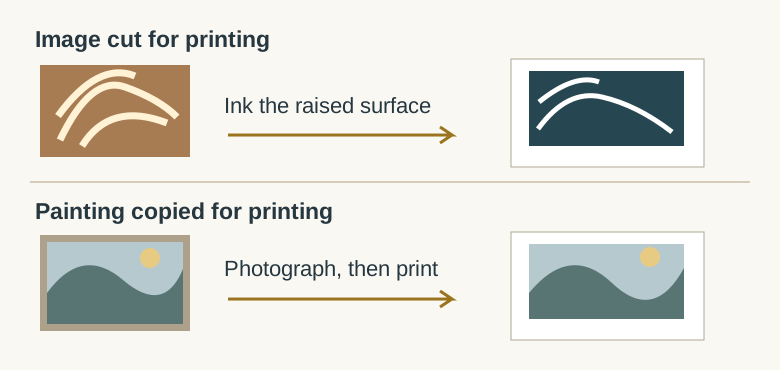
What does the listing actually describe?
| Listing term | What to ask |
|---|---|
| Original print | What plate, block, stone, screen or file did the artist make for this work? |
| Authorized reproduction | Which existing work was copied, and who approved the release? |
| Giclée | What was the source of the image sent to the printer? |
| Original digital print | Did the artist intend the printed sheet as a finished work? |
| Poster | Was the design made for the poster or adapted from another work? |
An original print starts with a work made for printing
In an etching, ink sits in recessed lines on a plate. In a woodcut or linocut, ink sits on the raised parts left after carving. Lithography transfers an image from a prepared flat surface. Screenprinting pushes ink through open parts of a stencil. A specialist printer can pull the edition in collaboration with the artist. Ask who made the image and which workshop printed it.
An authorized reproduction starts with another finished work
An artist can license a publisher to photograph a finished painting and issue signed copies. Ask for the painting’s title, the publisher and the edition details. A pencil signature belongs in the description, alongside an accurate account of what was reproduced.
Giclée tells you how ink reached the paper
Giclée is an inkjet printing term. A studio can use the same printer for a scan of a canvas, a photograph or a drawing made on a tablet. Paper texture, a description such as archival pigment and a close-up of the dots can help explain production quality. Each leaves the source-image question open.
A digital original can finish on paper
An artist draws directly into a file, selects a paper and approves the printed color and scale. If the artist intended those sheets as the finished work, an inkjet edition can be an original digital print. Ask whether another size, file version or open edition also exists.
A poster can have its own original design
An exhibition poster might reproduce a painting above the opening dates. A designer might also draw the lettering and image specifically for that poster. Look at the credits along the bottom and ask what the printer or publisher issued. Keep the poster’s design history separate from its paper quality.
What a photograph of the surface can settle
A plate indentation around an image is consistent with some intaglio processes. It can also be embossed separately. A crop may hide it entirely. Ask for the image edge in angled light and a reference for the exact edition. If a listing calls a print both an etching and a reproduction of an etching, have the seller put the process used on this particular sheet on the invoice.