Print Edition Mark Decoder
A mark like AP 2/10 can tell you which group a print belongs to and which record to ask the seller for. Enter the inscription from your sheet to see what it usually means.
Find the mark on your sheet
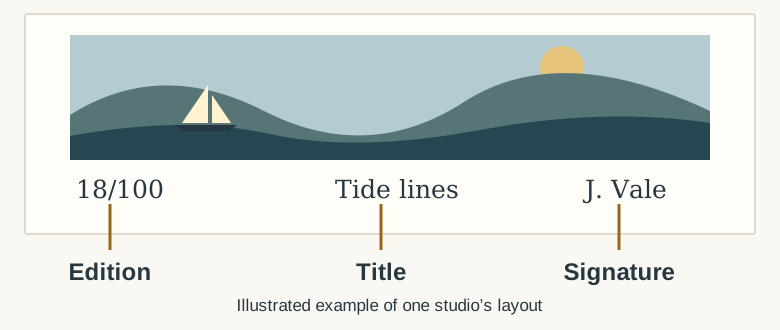
Numbered edition (18/100)
The first number identifies this impression. The second gives the stated size of the numbered edition. The fraction alone tells you neither the order of printing nor how many proofs exist. Ask for the publisher’s edition record and a photograph of the full lower margin.
Artist’s proof (A/P or E.A.)
AP and EA (épreuve d’artiste) usually identify impressions set aside for the artist. In AP 2/10, the fraction usually refers to a group of ten artist’s proofs, separate from the numbered edition. Ask how many artist’s proofs were recorded and whether this one matches the published edition in paper, color and size.
Printer’s proof (P/P)
A printer’s proof is an impression set aside for the printer or workshop. A printer’s blindstamp is a separate mark and can also appear on regular edition prints. Ask which workshop received the proof and whether its stamp or records match this sheet.
Hors commerce (H/C)
Hors commerce means outside commerce. Publishers may use HC for presentation or other impressions set aside from the regular sale edition. Such a sheet can later change hands. Ask who originally received this impression and how the publisher recorded it.
Bon à tirer (B.A.T.)
The artist approves this impression as the example for the printer to follow. A BAT can preserve a particular choice of ink, paper or color. Ask for the workshop record identifying the approved impression and a close view of its inscription.
Trial proof (T/P)
A trial proof tests the work while it is being developed. A color or detail can differ from the finished edition. The abbreviation alone cannot tell you what changed. Request photographs of this trial and the published version at the same scale. Ask the seller to identify the difference.
What if the inscription looks different?
A Roman numeral, a workshop code or a handwritten dedication can sit beside an edition mark. Keep the entire inscription together when asking the publisher. A matching fraction or proof mark gives you a lead. Authenticity and value also depend on the print, its history and the edition record.